Hampta Pass Trekking: Complete Guide
Imagine walking through lush green meadows under a warm Himachali sun, and waking up the next morning to glaciers and barren cold desert. That is the Hampta Pass Trekking — a trail where two entirely different worlds collide in the most breathtaking way possible.
At Wild Hike Adventures, we have guided hundreds of trekkers through this remarkable crossing, and every single time — without exception — someone stops mid-trail, turns around, and says: “I had no idea India looked like this.”
This guide will walk you through everything you need to know before you lace up your boots: the route, the best time to go, what to pack, how to acclimatize, and why the Hampta Pass Trek deserves a spot at the very top of your adventure bucket list.
What Makes Hampta Pass Special?
The Hampta Pass Trekking sits at an elevation of 4,270 meters in the Kullu district of Himachal Pradesh. What truly sets it apart from most Himalayan treks is the contrast — almost nothing in the trekking world can match the visual drama of crossing from the verdant Kullu Valley into the stark, moon-like terrain of Lahaul and Spiti in a single day.
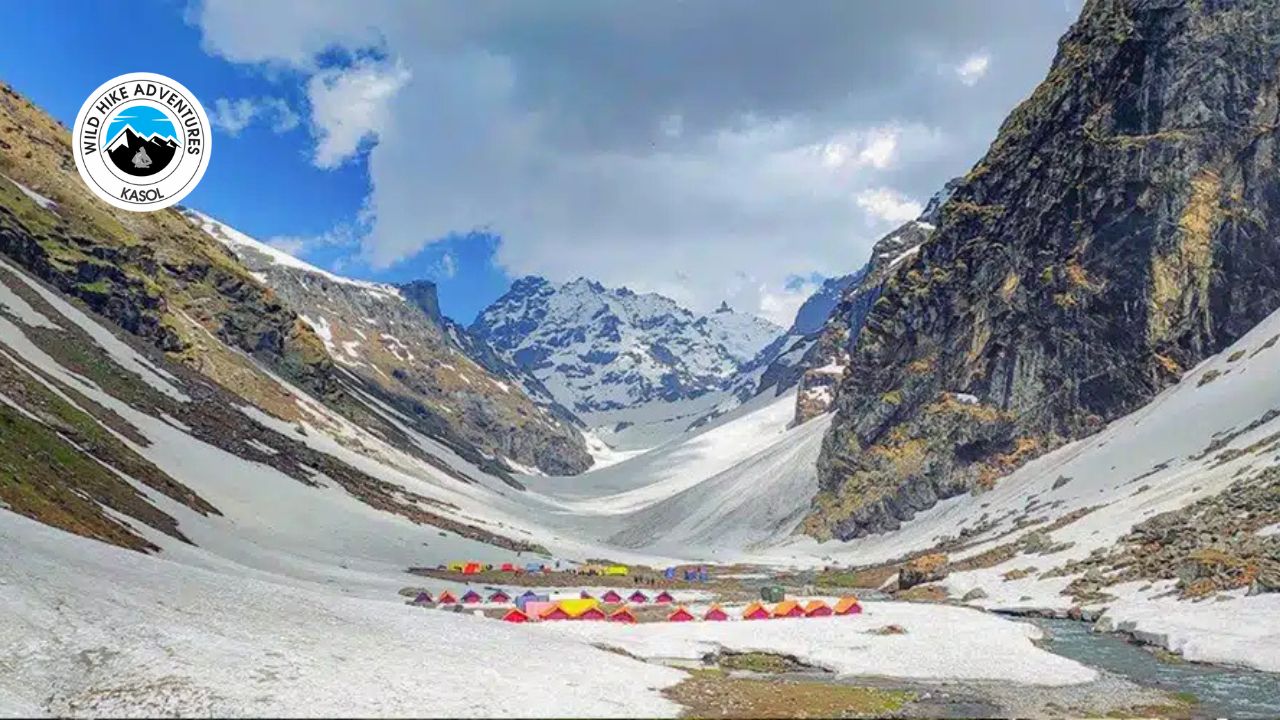
On one side of the pass, you have dense forests, wildflower meadows, roaring rivers, and the smell of pine in the air. On the other side: silence. A vast, high-altitude cold desert where the landscape is painted in shades of grey, brown, and dusty ochre. This isn’t just a trek — it’s a geological time-lapse.
Day-by-Day Itinerary
Day 1
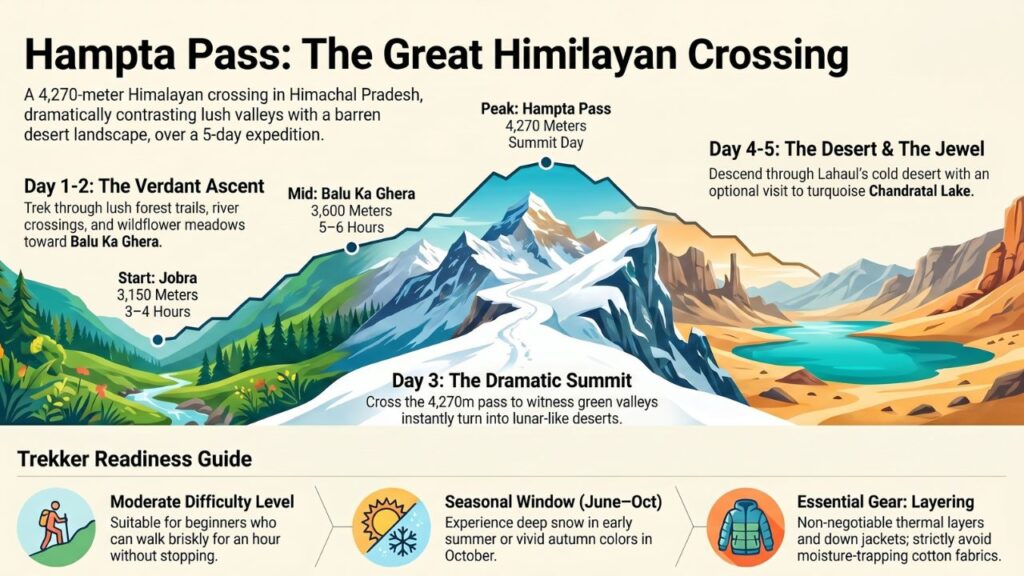
Manali to Jobra → Chika Campsite: Drive to Jobra (3,150 m), then trek 3–4 hours to the Chika meadow campsite. An easy start through forest trails with some river crossings along the way. The perfect introduction to the trail.
Day 2
Chika to Balu Ka Ghera: A 5–6 hour trek through the stunning Jwara meadows, arriving at Balu Ka Ghera (3,600 m). The views of Deo Tibba peak from camp here are extraordinary, especially at sunrise.
Day 3
Balu Ka Ghera → Hampta Pass → Shea Goru: The big day. You summit the pass at 4,270 meters, cross glaciers and snowfields, and descend into Lahaul. This is the moment the landscape transforms completely — from green to grey, from lush to lunar. Nothing prepares you for it.
Day 4
Shea Goru to Chatru: Trek through the Lahaul cold desert to Chatru (3,300 m). Optional jeep extension to the breathtaking Chandratal Lake — a glacial lake that sits like a turquoise jewel in the middle of nowhere.
Day 5
Chatru → Manali (Return): Drive back via Rohtang Pass. If you skipped Chandratal on Day 4, this is your second chance for a detour before heading home.
Best Time for the Hampta Pass Trek
The Hampta Pass Trek is open from late June through mid-October, but the experience shifts significantly depending on when you choose to go.
- June–July is magical. Snow on the pass is at its thickest, wildflowers bloom across the meadows, and the rivers run loud with snowmelt. Days are warm and pleasant; nights at camp dip close to freezing.
- August–September brings the monsoon, which mostly affects the Kullu side while leaving Lahaul relatively dry. The landscape turns a vivid green, the trails feel alive, and post-rainfall skies offer some of the clearest mountain views of the year.
- October is perfect for those who prefer crisp cold-weather trekking. Crowds thin out considerably, the skies turn a deep, impossible blue, and the autumn colours on the Kullu side are absolutely stunning.
At Wild Hike Adventures, we run scheduled group batches from June through October, with private treks available year-round on request.
Fitness Level Required
The Hampta Pass Trek is rated moderate — comfortably within reach for most healthy adults who exercise regularly, but not a casual weekend outing. You will cover 8–12 km per day on uneven terrain, gain and lose significant elevation, and spend three nights sleeping above 3,500 meters.
Our honest recommendation: if you can walk briskly for an hour without stopping and have done at least a few day hikes in hilly terrain, you are ready. If you are completely new to trekking, consider starting with a shorter trail first — like the Kheerganga Trek — to understand how your body responds to altitude before attempting the Hampta Pass crossing.
Practical Tips Before You Go
- Acclimatize First Spend at least one night in Manali (2,050 m) before starting the trek. Your body will thank you on Day 3 at the pass.
- Pack Light, Layer Smart Thermal base layers, a good down jacket, waterproof shell, and trekking pants are non-negotiable. Avoid cotton — it traps moisture and gets dangerously cold at altitude.
- Hydration Is Non-Negotiable At altitude, you lose water faster than you realize. Aim for at least 3–4 litres per day, even if you do not feel thirsty.
- Know the Signs of AMS Headache, nausea, and dizziness at altitude are warning signals — stop ascending immediately. All Wild Hike Adventures guides carry emergency oxygen and a full first-aid kit on every trek.
Essential Packing List
- Trekking shoes with good ankle support (waterproof preferred)
- Thermal inner layers — top and bottom
- Fleece mid-layer and insulated down jacket
- Waterproof outer shell jacket and pants
- Trek pants (2 pairs) and moisture-wicking t-shirts
- Warm gloves, wool socks (3–4 pairs), and a woollen cap
- Trekking poles — highly recommended for the pass crossing
- Sunscreen SPF 50+, UV-protection sunglasses, and a wide-brimmed hat
- Personal first-aid kit, Diamox (consult your doctor), and Dolo 650
- Power bank and a headlamp with extra batteries
- Reusable water bottle (minimum 2 litre capacity)
Why Choose Wild Hike Adventures?
There are many operators offering Hampta Pass Trek packages. Here is what makes Wild Hike Adventures different:
- Certified Mountain Guides — Every guide is first-aid trained, experienced in high-altitude rescue, and deeply familiar with the Hampta Pass route in all weather conditions.
- Small Group Sizes — We cap our groups at 12 trekkers. More personal attention, less trail congestion, and a far closer-knit experience on the mountain.
- Quality Camping Gear — Our tents, sleeping bags, and kitchen setup are maintained to high standards. Good sleep at altitude makes a genuine difference to your trek.
- Responsible Trekking — We follow Leave No Trace principles on every single trek. The mountains deserve to stay as wild and clean as they are today.
- Transparent Pricing — Everything is included: accommodation, meals, permits, transport, and guide fees. No hidden costs, ever.
FAQs
How difficult is the Hampta Pass Trek?
The trek is graded as Moderate. While it doesn’t require technical mountaineering skills, it involves steep ascents, descent over scree and boulders, and crossing snow patches (especially in early summer). It is suitable for beginners with a basic level of fitness and seasoned trekkers alike.
Do I need a permit for the trek?
Yes. Permits are required for trekking and camping in the Kullu and Lahaul regions. When you trek with an operator like Wild Hike Adventures, these permits and forest fees are typically handled by the team and included in your package.
Is there mobile network or electricity on the trail?
– Network: You will likely lose signal shortly after leaving Jobra (Day 1). There is no mobile connectivity at Chika, Balu Ka Ghera, or Shea Goru.
– Electricity: There are no charging points once you leave Manali. It is essential to carry a high-capacity power bank for your cameras and phones.
How do we manage drinking water?
The trail follows the Rani Nallah river for a large portion. Your guides will identify clean, fresh-water springs for refills. It is recommended to use water purification tablets or a filtered bottle if you have a sensitive stomach.
What happens if I get Altitude Sickness (AMS)?
Our guides are trained to monitor your oxygen levels and heart rate. If you show symptoms of Acute Mountain Sickness (AMS), the standard protocol is to descend immediately to a lower altitude. We carry emergency oxygen and first-aid kits to manage these situations.
Conclusion
The Hampta Pass Trek is not just another line on a completed list. It is a genuine adventure — the kind that leaves you with stories worth telling for years. The crossing itself, that moment when you stand at the summit and look back at green Kullu on one side and the grey vastness of Spiti on the other, is one of those rare travel experiences that actually delivers on the hype.
At Wild Hike Adventures, we believe the mountains have a way of putting everything in perspective. The Hampta Pass Trek has a way of reminding even the most city-bound among us what it truly feels like to be completely, genuinely alive.